Tiny Onion, Big Gut: Quercetin & Prebiotics
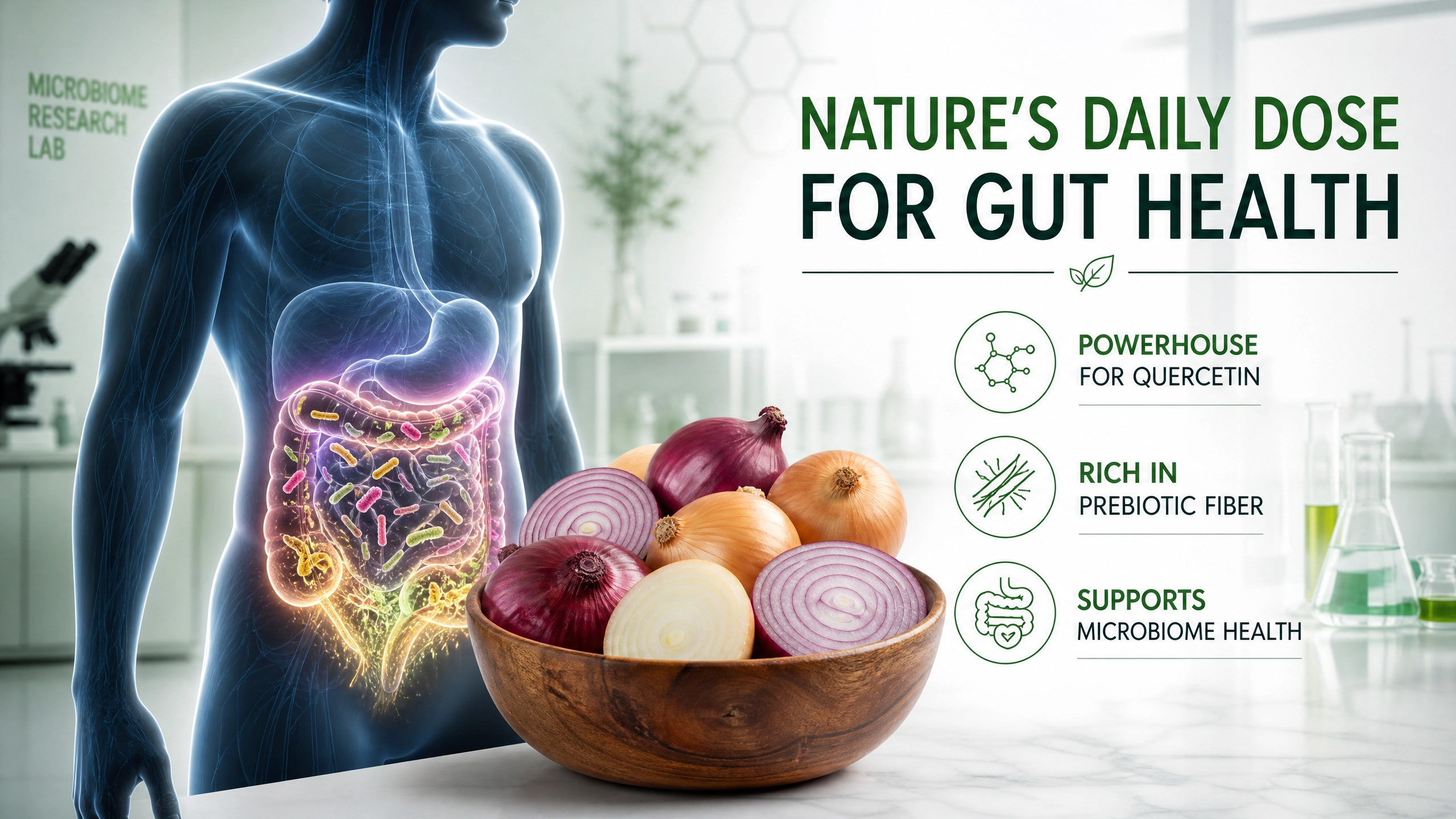
The Humble Onion: A Powerhouse for Quercetin, Prebiotics, and Microbiome Health
At HealthMedHub, we are constantly exploring nature’s pharmacy. While often dismissed as a simple culinary staple, the common onion (Allium cepa) is emerging in peer-reviewed research as a potent functional food. Specifically, its unique combination of quercetin (a flavonoid antioxidant) and inulin-type fructans (a prebiotic fiber) positions it as a key player in gut microbiome modulation. This article dissects the specific science of how onions serve as a dual-action agent for systemic health, focusing exclusively on their role in quercetin bioavailability, prebiotic activity, and microbial ecology.
The Chemistry of the Onion: Two Active Principles
To understand the therapeutic potential, we must differentiate between the two primary bioactive components in onions. While all onions contain these, the concentration varies significantly by color and variety.
Quercetin: The Flavonoid Antioxidant
Quercetin is a polyphenolic flavonoid found abundantly in the outer rings of red and yellow onions.
- Mechanism: It acts as a potent free radical scavenger and an inhibitor of mast cell degranulation (histamine release).
- Bioavailability: Onion quercetin has higher bioavailability compared to other sources (like apples or tea) due to the presence of sugar moieties (glucosides), which are more easily absorbed in the small intestine (Hollman et al., 1995, PubMed).
- Key Research: Studies on NIH PubMed (e.g., J Nutr. 2002) demonstrate that consuming 100g of red onion significantly increases plasma quercetin levels, reducing oxidative stress biomarkers.
Inulin & Fructooligosaccharides (FOS): The Prebiotic Fiber
Onions are one of the richest dietary sources of inulin and FOS—soluble fibers that resist digestion in the upper gastrointestinal tract.
- Mechanism: These fructans reach the colon intact, where they serve as a fermentation substrate for beneficial bacteria.
- Specificity: Unlike generic fiber, onion-derived FOS selectively stimulates the growth of Bifidobacterium and Lactobacillus species (Gibson & Roberfroid, 1995, PubMed).
Synergistic Action on the Gut Microbiome
The therapeutic power of the onion lies not just in its individual components, but in their synergistic effect on the gut ecosystem.
How Quercetin Protects the Gut Barrier
Recent research indicates quercetin is not merely an antioxidant; it directly modulates the gut environment.
- Barrier Integrity: Quercetin upregulates the expression of tight junction proteins (e.g., occludin, claudin) in the intestinal epithelium. This reduces “leaky gut” permeability (Suzuki & Hara, 2009, Biosci Biotechnol Biochem).
- Prebiotic Quercetin Metabolism: Gut bacteria metabolize quercetin into smaller phenolic acids, which are more bioactive than the parent compound. This creates a bidirectional relationship: the prebiotic (inulin) feeds the bacteria, and the bacteria convert the flavonoid (quercetin) into anti-inflammatory metabolites.
The Prebiotic Cascade: Inulin as Fuel
When inulin and FOS are fermented by the colonic microbiome, the following occurs:
- Short-Chain Fatty Acids (SCFAs): The primary fermentation byproducts are butyrate, propionate, and acetate.
- Butyrate is the primary fuel source for colonocytes (colon cells).
- Propionate modulates hepatic glucose production.
- Microbial Diversity: Regular consumption of onions has been linked to increased alpha-diversity in the gut—a hallmark of a robust microbiome (Slavin, 2005, Crit Rev Food Sci Nutr).
Best Onion Varieties for Maximum Efficacy
Not all onions are created equal. For targeted therapy, choose based on color and pungency.
| Variety | Quercetin Content | Fructan/Inulin Content | Best Use |
|---|---|---|---|
| Red Onion | Highest (10x higher than white) | Moderate | Raw (salads, salsas) for quercetin |
| Yellow Onion | Moderate | Highest (Fructans) | Cooked (soups, roasts) for prebiotic fiber |
| White Onion | Low | Low | Minimal therapeutic value |
| Shallots | High (similar to yellow) | Moderate | Balanced raw or cooked |
Key Tip: To maximize quercetin absorption, consume onions raw or lightly cooked. For maximal prebiotic inulin, cooking is acceptable as it reduces pungency but retains the fiber.
Practical Integration: How to Eat Onions for the Gut
To achieve the dual effect of quercetin delivery and prebiotic fermentation, follow these evidence-based protocols:
- Raw for Quercetin: Consume 1/2 a raw red onion (approx. 50g) daily in salads or on sandwiches. Chewing activates the enzyme alliinase, which releases other beneficial sulfur compounds.
- Cooked for Prebiotics: Slowly caramelize yellow onions. The heat breaks down the harsh thiosulfinates but preserves the inulin structure.
- Timing: Eating onions earlier in the day allows for more complete SCFA fermentation during waking hours, potentially reducing gas discomfort at night.
Potential Side Effects & Precautions
While onions are generally safe for most people, specific populations must exercise caution due to their potent biological activity.
- Gastrointestinal Distress: High intake (over 100-150g daily) of raw onions can cause bloating, flatulence, and cramping, especially in individuals with Irritable Bowel Syndrome (IBS) or Small Intestinal Bacterial Overgrowth (SIBO) . This is due to the high FODMAP content (fructans).
- Blood Thinning: Quercetin has mild anti-platelet activity. While rare, individuals on anticoagulant medications (e.g., Warfarin) should consume large amounts of onion extracts cautiously. Normal dietary intake is not usually a concern.
- Acid Reflux: Raw onions can relax the lower esophageal sphincter (LES), exacerbating GERD symptoms.
- Allergy: True onion allergy is rare but possible, presenting as contact dermatitis or oral allergy syndrome.
- Sulfur Sensitivity: The sulfur compounds in onions may cause skin irritation or contact dermatitis in sensitive individuals.
- Pregnancy & Breastfeeding: Dietary consumption is safe, but concentrated onion supplements are not recommended without consultation.
Conclusion
The onion is a rare example of a dual-function functional food. By providing both a direct antioxidant (quercetin) and a specific prebiotic substrate (inulin), it supports the gut microbiome in a way that singular supplements cannot replicate. For those looking to enhance microbial diversity, improve gut barrier function, and increase systemic flavonoid intake, adding red and yellow onions to the daily diet is a simple, cost-effective, and scientifically validated strategy.
Medical Disclaimer: The content provided on HealthMedHub is for informational purposes only and is not intended as a substitute for professional medical advice, diagnosis, or treatment.
References
- Hollman, P. C., et al. (1995). Absorption of dietary quercetin glycosides and quercetin in healthy ileostomy volunteers. The American Journal of Clinical Nutrition, 62(6), 1276–1282. [PubMed ID: 7491880]
- Gibson, G. R., & Roberfroid, M. B. (1995). Dietary modulation of the human colonic microbiota: introducing the concept of prebiotics. The Journal of Nutrition, 125(6), 1401–1412. [PubMed ID: 7782892]
- Suzuki, T., & Hara, H. (2009). Quercetin enhances intestinal barrier function through the assembly of zonula occludens-2, occludin, and claudin-1 and the expression of claudin-4 in Caco-2 cells. The Journal of Nutrition, 139(5), 965–970. [PubMed ID: 19297425]
- Slavin, J. L. (2005). Dietary fiber and body weight. Nutrition, 21(3), 411–418. [PubMed ID: 15797685]
- Scalbert, A., & Williamson, G. (2000). Dietary intake and bioavailability of polyphenols. The Journal of Nutrition, 130(8S Suppl), 2073S–2085S. [PubMed ID: 10917926]